Workshop 4 · Phase II
Moving Free
Fascia & mobility for desk-bound bodies
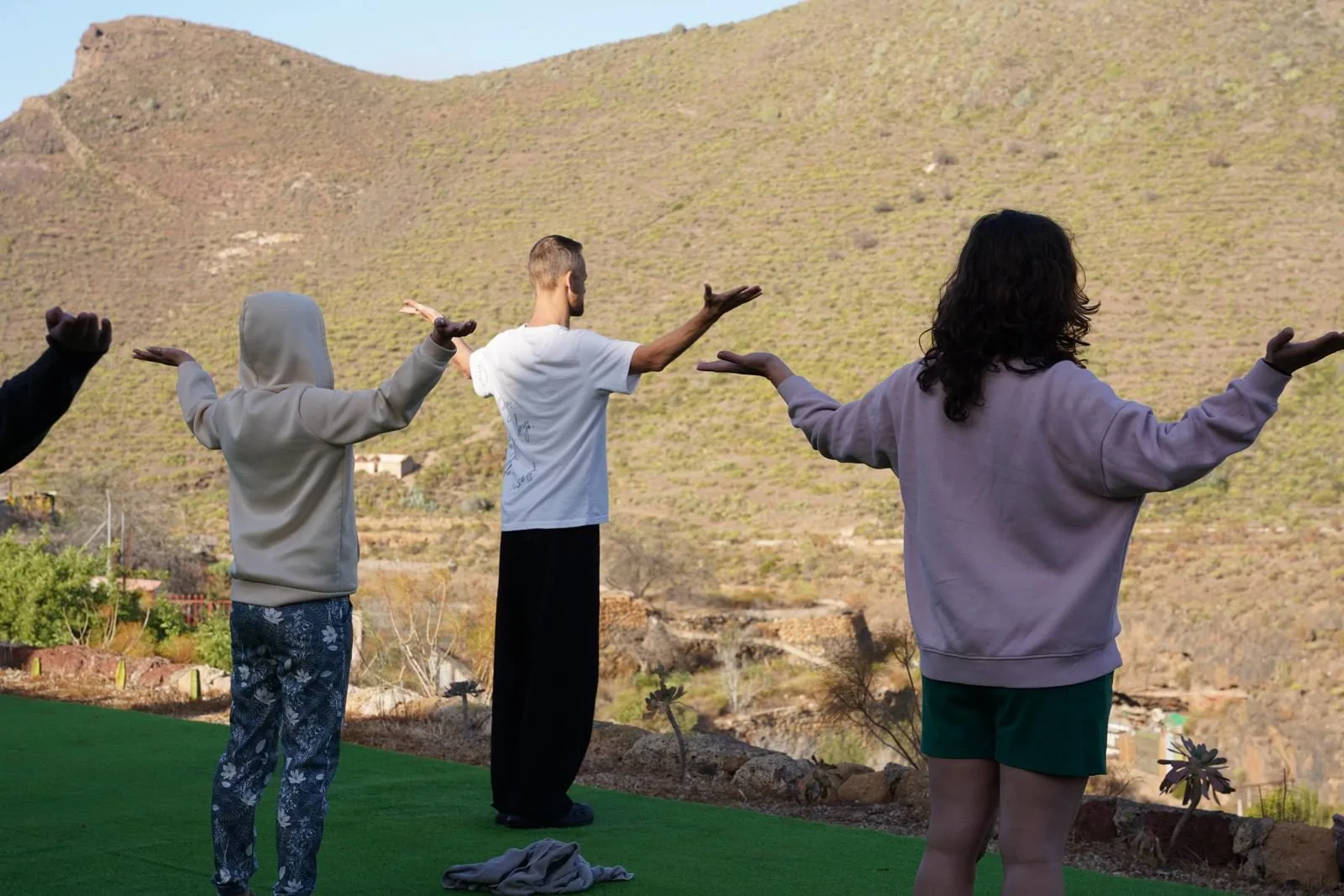
Every workshop opens with a 10-minute grounding ritual — feet, three breath cycles, orientation. The same each time, so you can arrive from anywhere.
Fascia — the connective tissue web that surrounds every muscle, organ, and bone — was largely ignored by Western anatomy until researcher Helene Langevin demonstrated in the early 2000s that it is a mechanically active tissue, densely innervated with sensory receptors. It does not respond well to aggressive stretching; it responds to slow, sustained load and hydration. Desk-bound posture thickens fascial layers over time, reducing glide between tissues and creating the diffuse tightness that stretching temporarily addresses but never resolves.
The sensation of being "stiff" is largely fascial — not muscular. And the way to change it is through attention and gentle, varied movement, not force.
Traditional Chinese Medicine describes fourteen meridian lines running through the body — channels through which qi flows. Modern anatomists have noted a striking overlap between these meridian pathways and the major fascial lines mapped by Thomas Myers in Anatomy Trains. The hip meridians — the Liver, Spleen, and Gallbladder channels — correspond precisely to the fascial restrictions most common in people who sit for long hours. Releasing them, in both traditions, begins with presence, not effort.
Live on Tenerife? There's a reduced rate for residents — send me a WhatsApp and we'll work it out.
No fixed dates yet — workshops launch later this season. WhatsApp me and I'll let you know when there's a date.
WhatsApp BastiaanThis workshop stands alone — and it is part of a journey. Each of the 9 workshops carries a bridge to what comes before and after.
See all 9 workshops →