Workshop 5 · Phase II
Flow
From stiff to supple movement
Every workshop opens with a 10-minute grounding ritual — feet, three breath cycles, orientation. The same each time, so you can arrive from anywhere.
Movement quality — how the nervous system organises and coordinates motion — is distinct from strength or flexibility. Somatic researcher Moshé Feldenkrais observed that most people use far more muscular effort than a movement requires, and that this unnecessary tension becomes habitual and invisible. The nervous system learns patterns, not muscles: it is always choosing the most familiar path, not the most efficient one.
Neuroscience calls this motor learning. Research shows that slow, attentive movement — the kind that keeps cortical involvement high — rewires these patterns more effectively than repetitive exercise. The felt sense of effort is not a sign of effectiveness. Often, it is the obstacle.
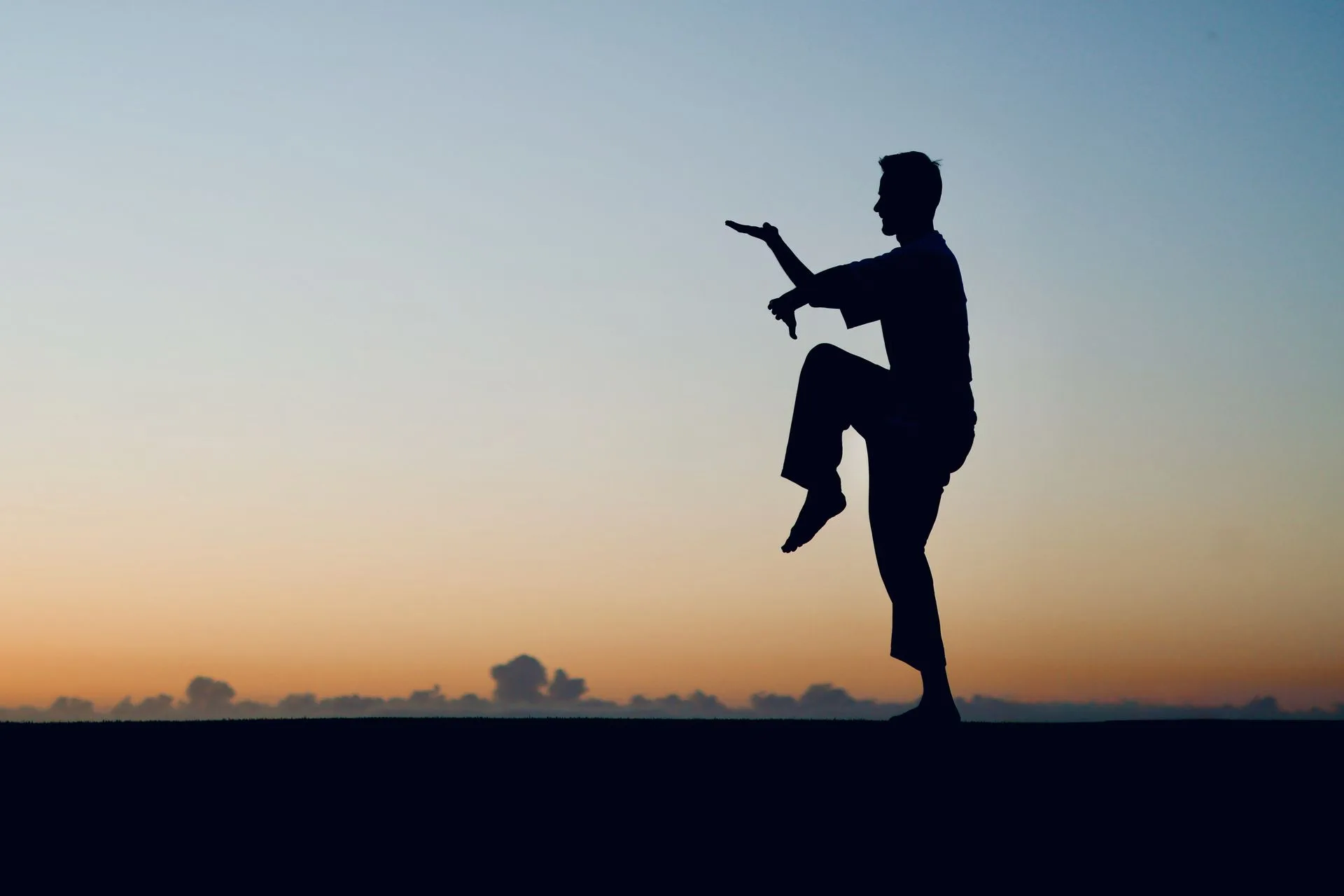
Wu wei — effortless action — is one of the central principles of Taoism. It is misunderstood as passivity, but in practice it means moving in alignment with the nature of things: without resistance, without excess, without forcing. In Tai Chi, the ideal movement leaves no trace of effort. A master's punch is not powered by muscle — it is a wave that travels from the ground through a fully connected, unobstructed body. Flow is not a feeling to achieve. It is what remains when unnecessary tension is removed.
Live on Tenerife? There's a reduced rate for residents — send me a WhatsApp and we'll work it out.
No fixed dates yet — workshops launch later this season. WhatsApp me and I'll let you know when there's a date.
WhatsApp BastiaanThis workshop stands alone — and it is part of a journey. Each of the 9 workshops carries a bridge to what comes before and after.
See all 9 workshops →