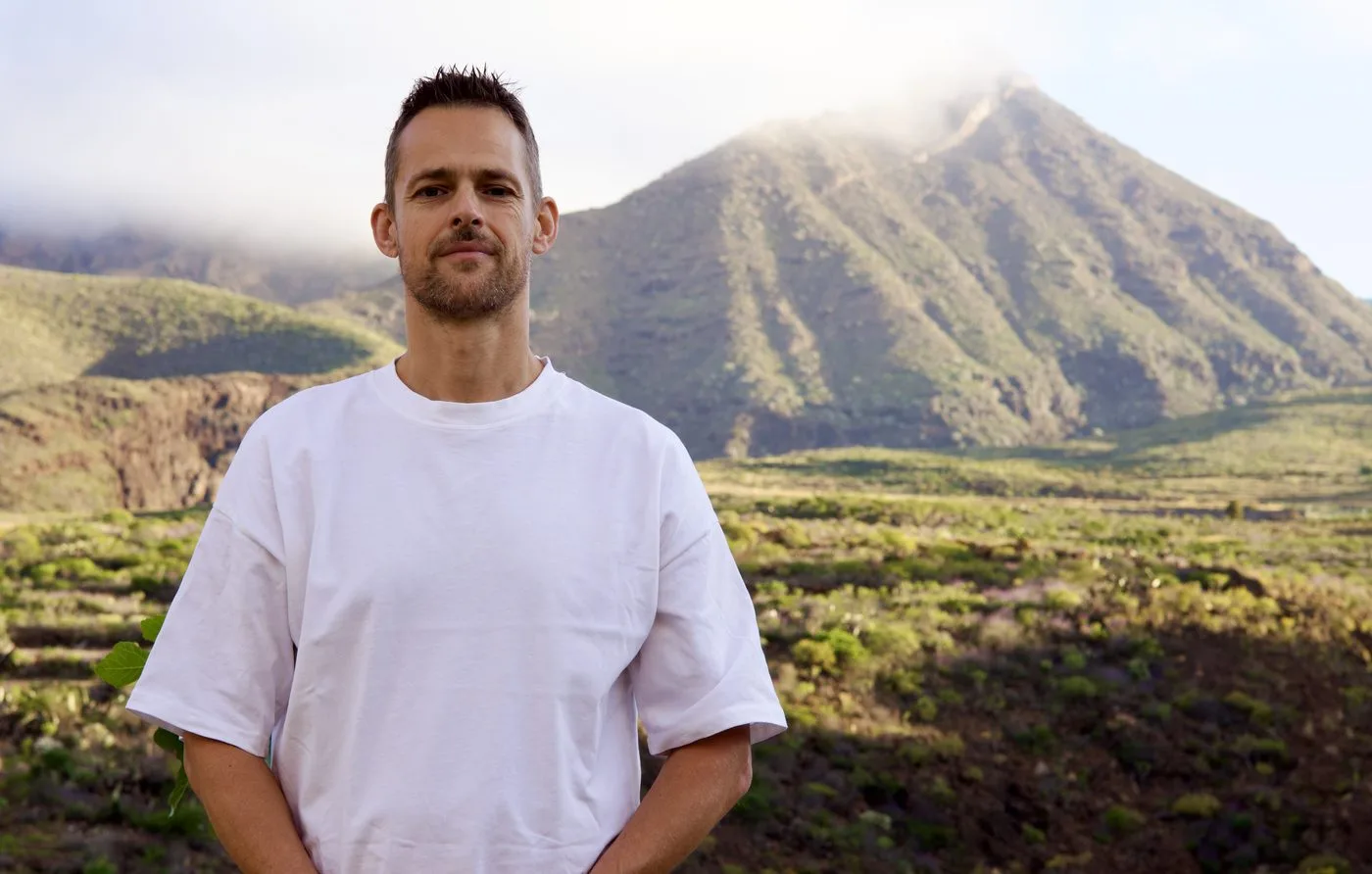
I started with Qigong when I was 18. Not because I was searching for peace or enlightenment, but because my teacher said: "You can train as hard as you like — if you don't learn to direct the energy, you're building on sand."
That stayed with me.
More than 30 years later, Qigong is the foundation of everything I do. Not as a separate practice, but as the lens through which I look at movement, breath, and the body.
What is Qi — and why should you care?
In Chinese medicine, Qi is the life energy that flows through everything. Through your body, along the meridians, via your breath. It sounds abstract. But if you have ever felt how a deep exhalation drops your shoulders, slows your heart rate, and makes the world momentarily quieter — you have felt Qi.
Western science names it differently: vagal activation, parasympathetic nervous system, heart rate variability. But they describe the same phenomenon. When energy can flow freely — through body and mind — there is health. When it stagnates, tension, pain, and exhaustion arise.
Qigong works with that principle. Not by forcing the problem, but by creating the conditions in which the body can restore itself.
The three pillars: move, breathe, be present
Every Qigong system is different, but three elements always return:
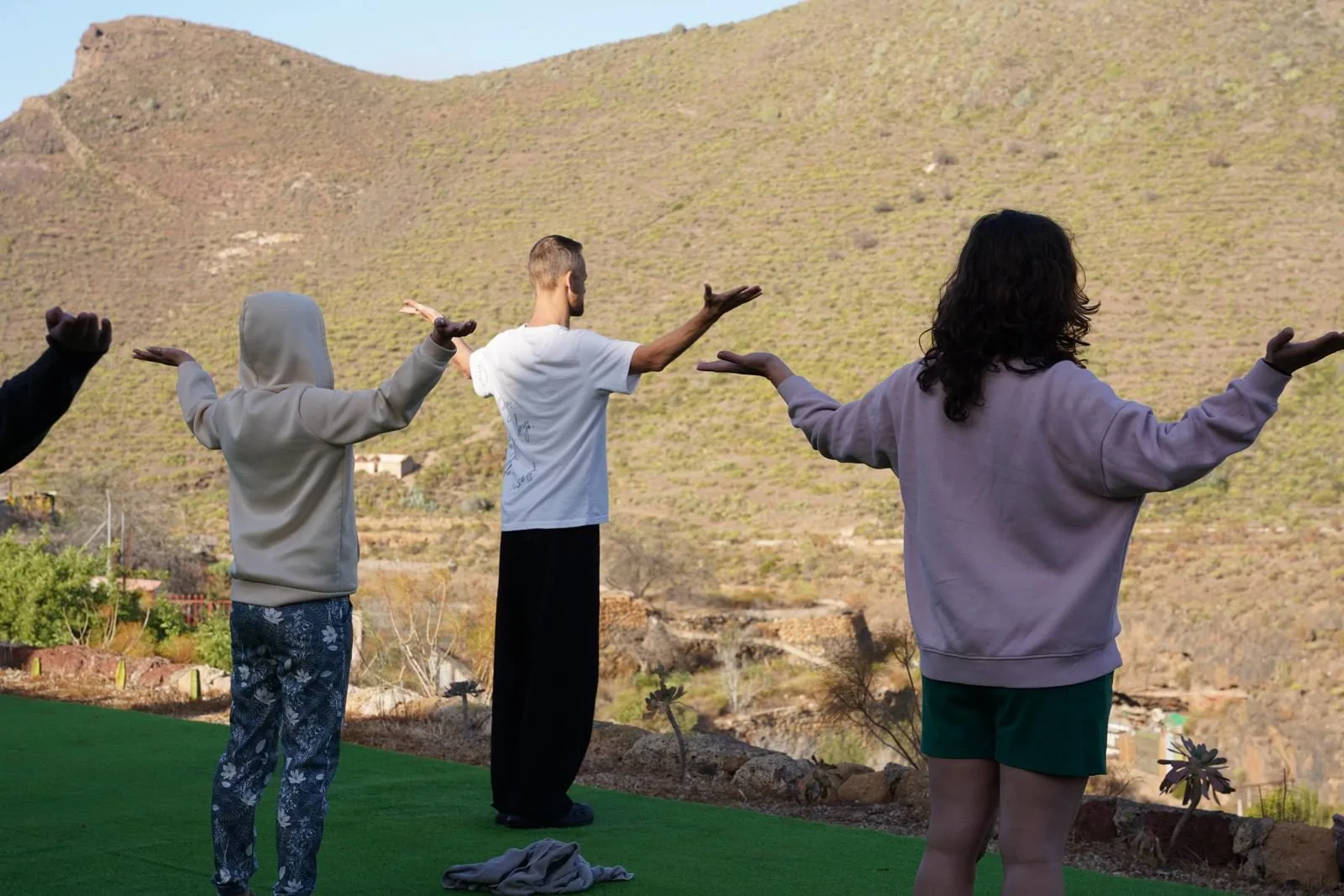
Movement — slow, flowing, with intention. Not to train muscles or burn calories. But to open the meridians, hydrate the fascia, and refine proprioception. The body learns to know itself again.
Breathing — in Qigong, breath is not something you add. It is the movement. The exhalation accompanies the expansion outward. The inhalation the return inward. When movement and breath run in sync, you activate a deeper layer of the nervous system.
Presence — Qigong without attention is gymnastics. The power lies in cultivating interoception: the ability to feel what is happening inside your body. Not through analysis, but through direct sensation. This is the part most people skip — and it is precisely the part that changes everything.
Why the nervous system is central
I work with Stephen Porges' Polyvagal Theory as a scientific framework for what I bring into Qigong practice. The core question is always: does the nervous system feel safe?
When the answer is yes, the body opens. Muscles relax. Movement becomes more fluid. Qi can flow.
When the answer is no — through chronic stress, trauma, or simply the constant pressure of modern life — the system is in survival mode. Every training session, every meditation, every breathing exercise works at half its potential.
Qigong begins with safety. Not by forcing it, but by giving the nervous system the signal again and again: it's okay. You can let go. You are here.
The Three Roots as starting point
In my work I use the Three Roots as the entry point:
The feet connect you to the earth. The acupuncture point Yongquan (Kidney 1) — literally "the source that bubbles" — sits in the hollow of your foot sole. When you bring your attention there while standing or walking, you activate proprioceptive signals that directly calm the parasympathetic nervous system.
The hips are the energy centre. The psoas — the only muscle that connects the spine to the leg — is also the muscle that stores the most stress. Frozen survival responses live here. Qigong movements that initiate from the hips help release this.
The shoulders are the barometer of the nervous system. Chronically raised shoulders are an incomplete startle response. When the shoulders truly drop — not by forcing, but by guiding the movement — the nervous system reads: the danger has passed.
Where to begin
You don't need a course to start tomorrow. Try this:
Stand. Feel your feet on the ground. Breathe slowly in through your nose — count to 4. Breathe slowly out — count to 6. Let your shoulders drop half a centimetre with the exhalation. Repeat for 5 minutes.
That is Qigong. Not the entire art — but the essence.
Feel it in your body — right now
Below is an 8-minute practice if you want to experience what this actually does. No experience needed, no equipment. Zhan Zhuang, Tai Chi opening form, and breath — enough to bring your nervous system one step down.
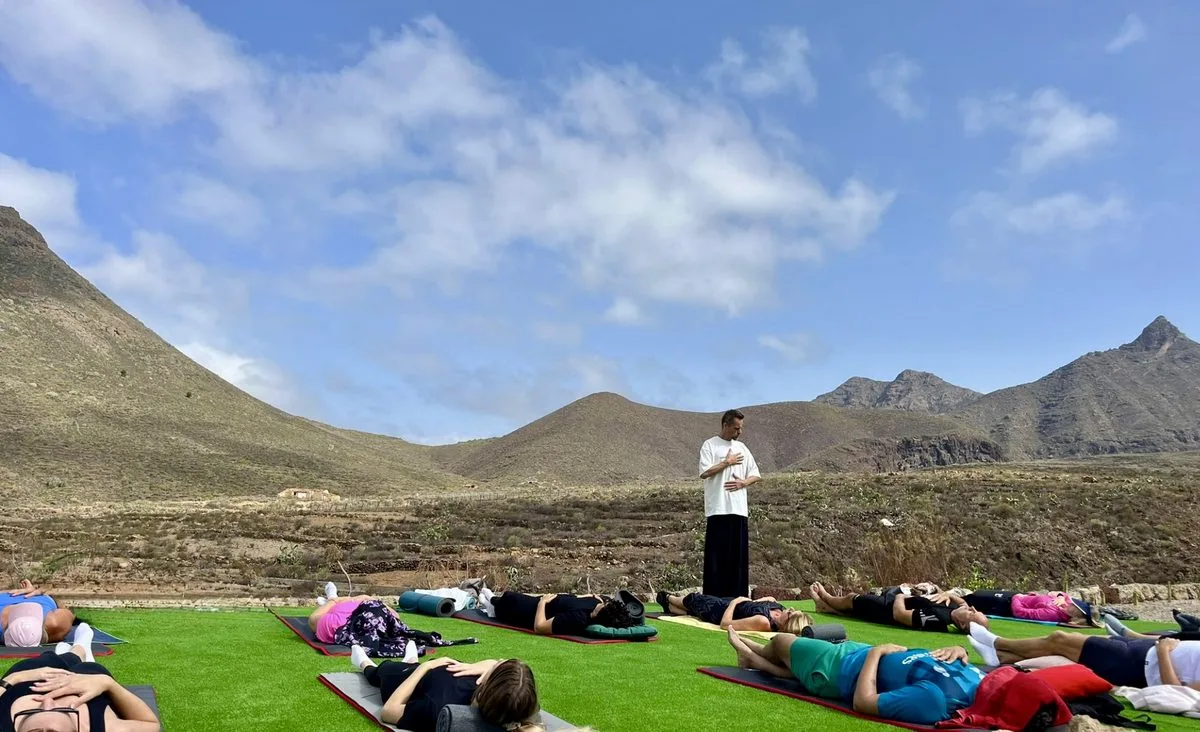
Want to go deeper? In my workshops I work specifically with the Three Roots, breathing, and nervous system regulation. Or get in touch for personal training, online or in Tenerife.