Most forms in Tai Chi, Bagua, or Qigong teach you to move the spine. Swimming Dragon Taiyi teaches you to be a spine — a single undulating line from heel to crown, where every joint, every breath, every fold of fascia participates in the same continuous wave.
I first began learning the form online with Sensei Hans Menck of the Freedom School in Pniel, South Africa, during the pandemic. Life moved on, training fell away — and now, a few years later, I am preparing to return to it. Writing this is part of that return. After more than thirty years in martial arts — Tang Soo Do, Muay Thai, Chen and Yang Tai Chi, Qigong — I expected to recognise the territory when I first met this form. I did not.
Who is Sensei Hans Menck?
Hans started judo at age seven in 1980, then trained Kyokushin karate for eighteen years to third dan. He went to France to study Aikido under Christian Tissier and trained at Aikikai Honbu in Tokyo. Since 2004 his focus has been the internal Chinese arts — Baguazhang, Taiji Quan, Xing Yi Quan, Praying Mantis — and Swimming Dragon Taiyi, which he studied under Li Yong Liang and Yu Anren.
Along the way he also became — by all accounts — the first and possibly only foreigner to learn Lai Leo, a closed Shan martial art from the Burmese border. He has trained Muay Thai Buran under monk Kru Bah, and Capoeira under Mestre Saguin in Munich.
It is an unusual résumé. What matters is what he has done with it. From his home dojo in Pniel he teaches live and via Zoom worldwide — the full curriculum lives at freedommartialart.com.
What Swimming Dragon Taiyi actually is
Swimming Dragon Taiyi — formally Tai Yi You Long Gong (太乙游龙功) — is a Taoist form from the Wudang tradition. For most of its history it was a closed family practice in the lineage of Grandmaster Yu Anren, passed down from his grandfather Yu Shao, a famous general. Yu Anren broke that tradition in the 1980s and began teaching the form publicly; in 2019 his son Yu Shihai became the thirteenth Lineage Successor of the Tai Yi Swimming Dragon Sect. The system contains three forms: the slow, continuous Swimming Dragon Quan; the Riding the Wind Sword; and the 72 Closed Hands fighting application.
The founding legend tells of a Daoist master imprisoned for a long time. With almost no room to move in his cell, he developed a form that could be practised within the space of a single floor tile. His body became so vital and resilient that the local ruler eventually summoned him out of prison to teach martial arts in the royal household. The form is still famous for being practicable in a kitchen, on a balcony, in the width of your own shoulders.
There is a modern echo of that legend in Hans's own lineage. One of his teachers — Li Yong Liang, who teaches the form in Melbourne — once fell from a factory wall and broke his back. Doctors did not expect him to walk again. Through dedicated practice of Swimming Dragon Taiyi, he restored it. That is the kind of claim that sounds extravagant in writing; less so once you have spent time inside the form.
In practice, the form is one long, low, continuous flow of spiralling motion. There are no static postures to land in. The waist leads, the spine follows, the limbs trail behind like silk in a current. The body becomes a single twisting line from the sole of the rooted foot to the crown of the head. This is what Chinese internal arts call chan si jin — silk-reeling power — but here it is not a technique layered onto the form. It is the form.
The spiral that other forms don't have
In my experience, the spiral in Yang Tai Chi is soft, almost suggestive. In Chen it is explicit but punctuated — coil, release, coil again. In Swimming Dragon there is no punctuation. The spiral never lets go.
That sounds technical. The body experience is anything but. The form is a continuous wave that keeps the spine and the long fascial lines of the body genuinely supple — which, for someone whose other passions are surfing and skating, is the most relevant kind of strength I know. Mobility without slackness. Rooted without rigidity. The dragon does not perform; it simply refuses to stiffen.
Training a Taoist form through a screen
I should say this plainly: Zoom is not a substitute for being in the room with a teacher of Hans's calibre. There is no hands-on correction through a webcam. The transmission of pressure, of timing, of the small weight shift that turns a movement from mechanical to alive — that asks for physical proximity.
And yet. Swimming Dragon Taiyi is, at its heart, internal work. The form is not done with the body; it is done through the body, by attention. What a good teacher offers through a screen is the direction of attention — here, not there; this breath, not that one; slower, not bigger. Hans is exceptionally good at this. He sees what is happening in your spine from a head-and-shoulders Zoom tile in a way that should not be possible.
What Hans does that most teachers don't
The thing I value most is his patience with the spiral. He will return to a single weight shift, a single rotation of the kua, for weeks. Not as a drill. As an invitation to drop deeper into what is already there.
There is no performance language in his teaching. No "more powerful," no "extend further," no aesthetics. The criterion is always quality: did the wave actually move through, or did it stop somewhere? If it stopped, that is where the next class begins.
His own statement of purpose — "Freedom through health, skill and wisdom depends on self-sufficiency, self-defence ability and self-knowledge" — sounds abstract until you have trained with him. Then it becomes obvious he means it literally. The form trains all three at once.
A short video — for context, not for instruction
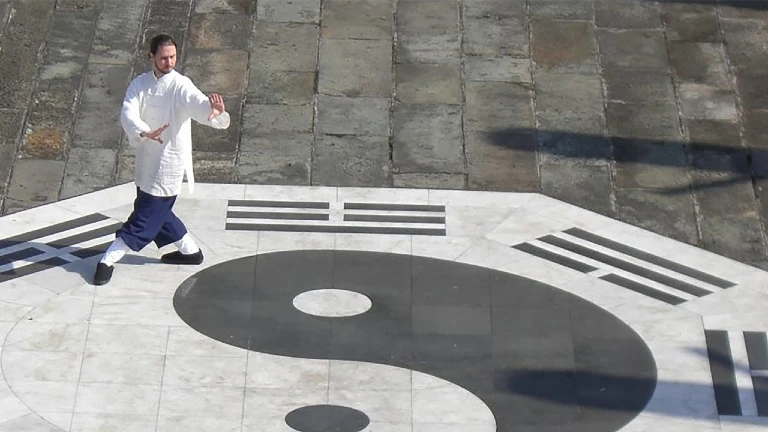
Below is a clip of my own practice. It is not a finished form. Swimming Dragon Taiyi takes years to embody, and what you will see is a student in the middle of that process, not a teacher demonstrating. I share it because seeing the movement makes the writing above make more sense.
My own practice of the form — online study under Sensei Hans Menck.
What this form is teaching me
The longer I have lived with Swimming Dragon — including the years when I was not actively training it — the more it functions less like a Tai Chi form and more like a diagnostic. Where the wave stops in the body is where the nervous system is holding. Where the spiral hesitates is where the fascia has been waiting decades to unwind. The form does not ask for strength or flexibility. It asks for continuity.
That is also why it is the practice I am ready to return to now. Swimming Dragon keeps the spine and the whole body supple in a way that translates directly into the other things I love — surfing, skating, the kind of moving that demands you can shift from any joint, in any direction, without warning. The dragon is the body's most honest expression of that readiness.
In the language we use at MindBodyInMotion: the dragon is what happens when feet, hips, and shoulders finally agree to be one body. When the three roots stop arguing. When earth and heaven move through the same spine without resistance.
That is the work. And after thirty years, it turns out the work is just beginning again.
If you want to study this form with the teacher I have described, visit freedommartialart.com — Hans teaches live and via Zoom worldwide. Or get in touch if you want to explore how spiral work fits into a personal training path.